Jews seem to have first settled in Yanovichi in the late 18th century. In 1897, the town was home to about 1,700 Jews, who made up approximately half of its total population. Under Soviet rule, many Jews practiced artisan trades, sometimes as members of cooperatives. Others became white-collar workers at state-owned institutions, while a few turned to farming. The town had a Jewish Ethnic Council and a state Yiddish school; both were closed down in the late 1930s. As a result of urbanization and industrialization, the number of Jews in Yanovichi had dropped to about 700 by 1939. In 1939-1940, Jewish refugees from Poland settled in the town. On July 9, 1941, Jewish refugees from Vitebsk reached Yanovichi, prompting a number of local Jews to try to flee eastward. Only a few managed to reach the Soviet interior. Some Jewish men were drafted into the Red Army.
Yanovichi was occupied by German troops on July 12, 1941. In early August, the Germans registered the Jews. In the middle of the month, they ordered them to wear a badge on their chests. A Jewish Council was appointed under Dr. Lifshits, who was fluent in German. In a number of operations carried out between late July and mid-August, members of Einsatzkommando 9 arrested most of the Jewish men, regardless of age, took them to nearby settlements, and murdered them. On August 25, 1941, the town's remaining Jews – children, women, and elderly people, in addition to the very few men left alive – were concentrated in a ghetto that had been set up on one street and surrounded with barbed wire. The road leading to the Russian cemetery passed through the ghetto, with gates at both ends. Non-Jewish residents were allowed to use this road, but were strictly prohibited from entering Jewish homes. Occasionally, Jewish inmates would mingle with the passers-by and manage to slip out of the ghetto. The appalling conditions in the ghetto inspired a revival of religious observance. Jews fasted and prayed for the abducted men to return home. Food supplies were scarce, but the inmates were able to barter their possessions for food and grow vegetables on plots inside the ghetto. Nevertheless, malnutrition and overcrowding led to the rapid spread of diseases. Lifshchits's concerns about a potential typhus epidemic appear to have hastened the decision to liquidate the ghetto, which was implemented in early September 1941.
Yanovichi was liberated by the Red Army on October 10, 1943.
Yanovichi
Surazh Vitebskiy District
Vitebsk Region
Belorussia (USSR) (today Yanavichy
Belarus)
55.293;30.702
Photos
Victims' Names
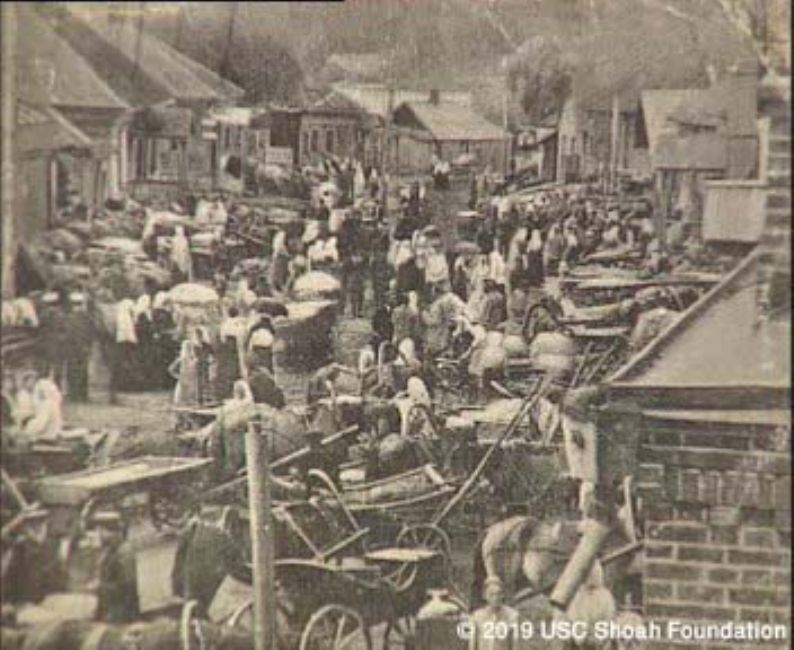
The market square in Yanovichi. A photograph from the interview with Boris Efros, USC Shoa Foundation Institute, copy YVA O.93/6471
USC Shoah Foundation Institute, University of Southern California, Copy YVA 14616941
The area of the former ghetto. Photographer: Alexander Litin, 2018.
YVA, Photo Collection, 14615431
The former Jewish cemetery in Yanovichi. Photographer: Alexander Litin, 2018.