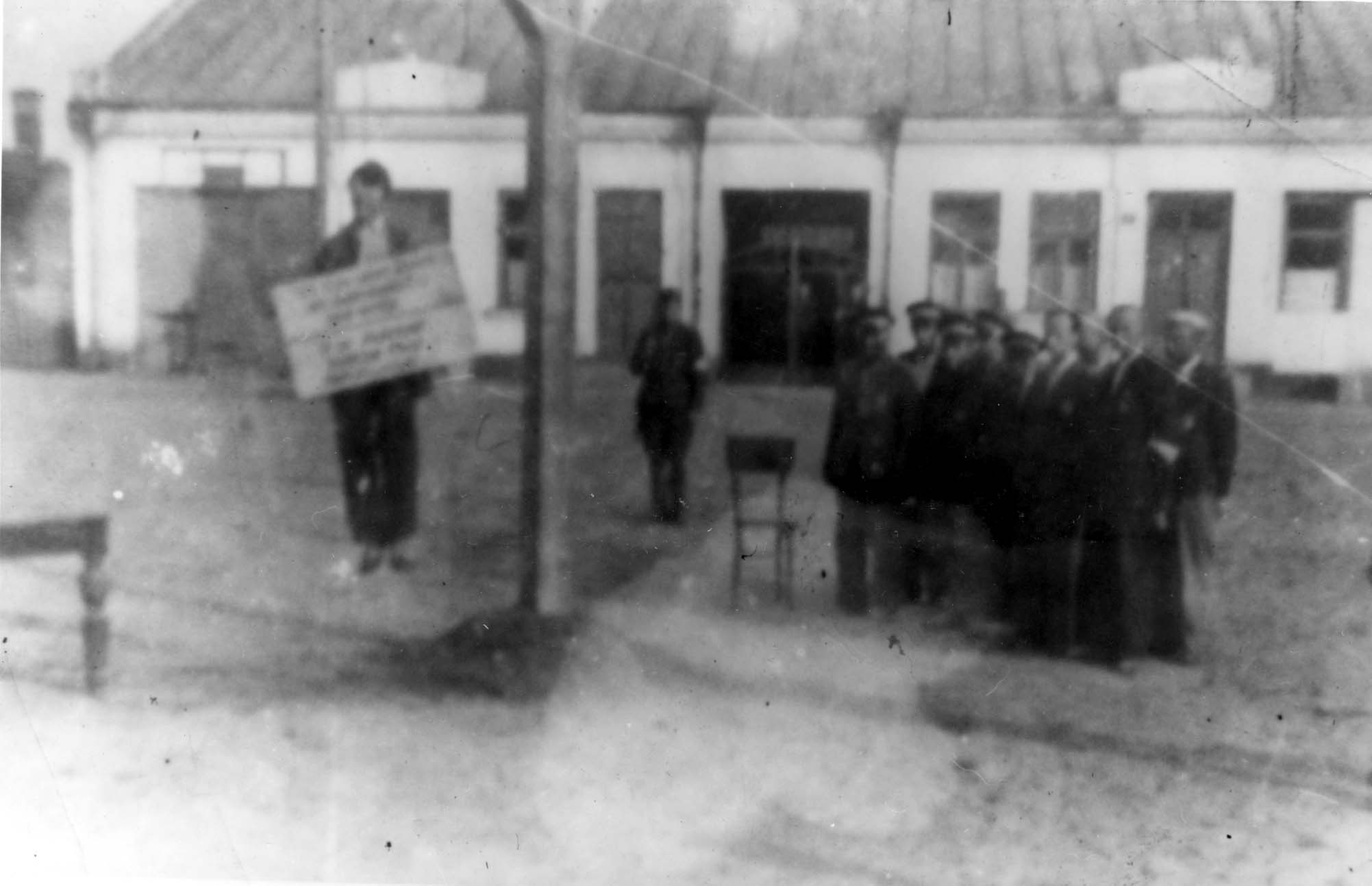
The public hanging of Yaakov Diner, who disobeyed German police orders, in the market square, before the eyes of the ghetto inmates and the Jewish order policemen.
The Jewish community of Zdołbunów experienced rapid growth after 1903, when the town had become an important railroad junction.
After World War I, Zdołbunów was incorporated into the Second Polish Republic. According to the 1921 census, the town was home to 1,262 Jews, who made up about 17 percent of the total population.
In the interwar period, local Jews made their living mostly from commerce and artisanship. The children of the community were educated at a Hebrew-language Zionist Tarbut school.
In September 1939, the Red Army entered Zdołbunów in the aftermath of the Molotov-Ribbentrop Pact, and the town became part of Soviet Ukraine. Under the new regime, private businesses were nationalized, and the Jewish school adopted Yiddish as its language of instruction.
On the eve of the German invasion, Zdołbunów was home to an estimated 1,500 Jews.
The Wehrmacht occupied Zdołbunów on June 30, 1941. In September 1941, control over the area was handed over to a German civil administration, and Zdołbunów became the administrative center of Gebiet Sdolbunow. Hundertschaftsführer Georg Marschall became the Gebietskommissar.
In the summer and fall of 1941, a number of anti-Jewish measures were implemented in Zdołbunów. Four weeks after the beginning of the occupation, the German authorities established a Judenrat (Jewish Council). Jews were required to wear distinguishing marks on their clothing (initially, these were armbands with the Star of David; they were eventually replaced with yellow patches). In the first days, Jews would simply be snatched off the streets and sent to perform forced labor. Jews were forbidden to leave the town limits and use the sidewalks.
On August 7, 1941, several hundred Jewish men – along with some Russians, Ukrainians, and Poles – were shot dead by an SD murder squad, with the assistance of the Ukrainian Auxiliary Police, at the Zdołbunów cement factory. Since most members of the first Judenrat were killed in this operation, a second Judenrat was formed, under the leadership of Symcha Szleifstein, who made considerable efforts to protect the interests of the community.
In the spring or early summer of 1942, a fenced-off ghetto was set up in Zdołbunów. Several hundred Jews from nearby villages, along with the remaining Jews of the town (some 1,000 people), were relocated there.
In August 1942, six elderly Jews, both male and female, were shot by the German Gendarmerie in the quarries of the town's cement factory.
Around this time, a group of Jews was saved thanks to the efforts of Hermann Friedrich Graebe (who would later be recognized as a Righteous among the Nations by Yad Vashem), the manager and chief engineer of the Zdołbunów branch of the German construction firm Josef Jung from September 1941 until January 1944. Graebe assisted a number of Jews in obtaining Aryan identity documents, and he tried to keep other Jews alive by employing them on various projects, including opening another fictitious branch office in Poltava, Ukraine. Graebe also cooperated closely with the head of the Judenrat, Szleifstein, and he interceded on the Jews' behalf, reducing the sums of the ransoms demanded by Gebietskommisar Marschall.
On October 13, 1942, the Zdołbunów Ghetto was liquidated, and its inmates were shot dead by an SD unit and some German gendarmes at a site outside of town, near the village of Stary Mylsk. In the period following this murder operation, some Jews who had been caught hiding were taken to the town's Jewish cemetery to be shot.
Zdołbunów was liberated by the Red Army on February 5, 1944.
Zdolbunow
Zdolbunow District
Wolyn Region
Poland (today Zdolbuniv
Ukraine)
50.521;26.250
Photos
Victims' Names
The public hanging of Yaakov Diner, who disobeyed German police orders, in the market square, before the eyes of the ghetto inmates and the Jewish order policemen.