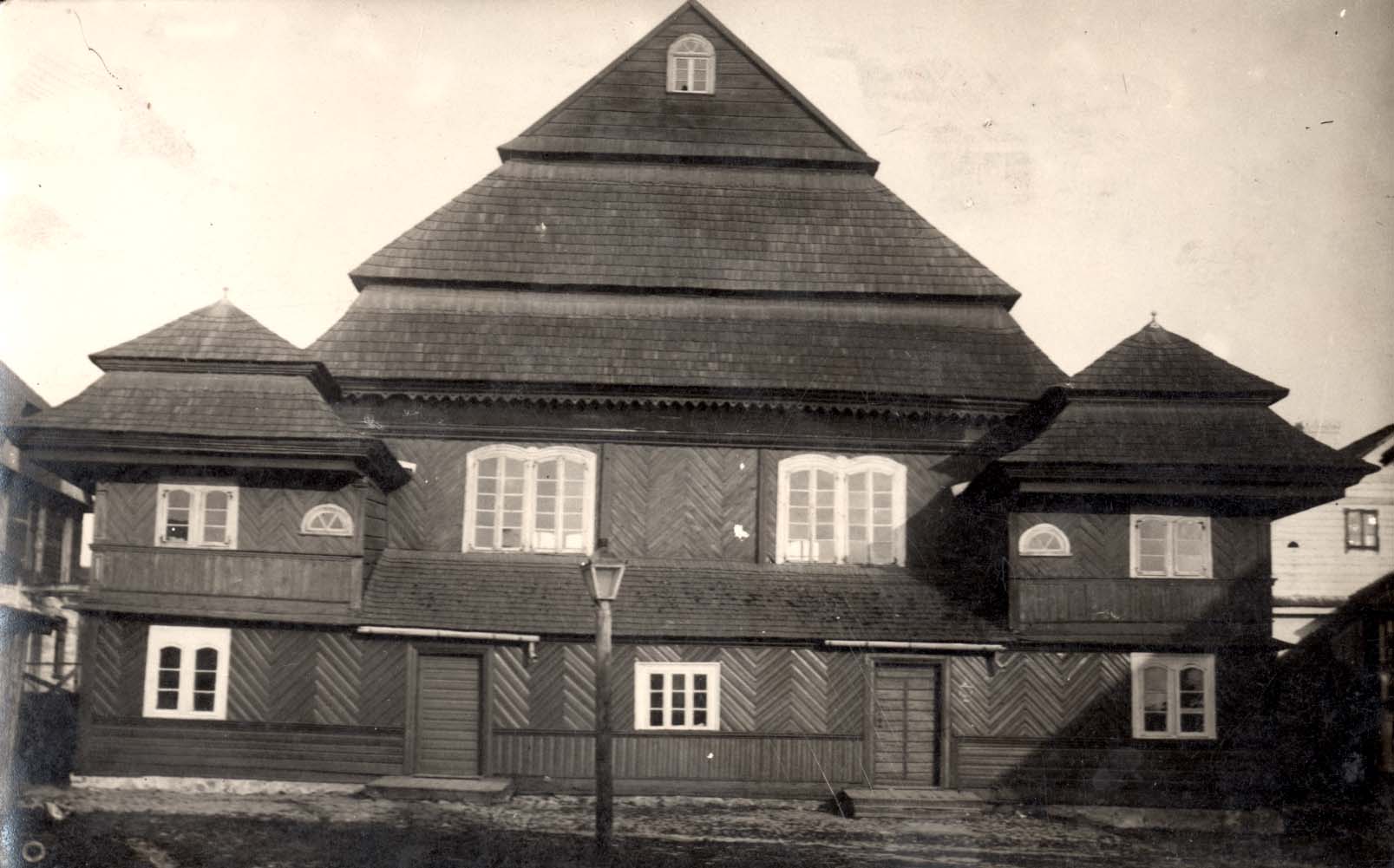
The first Jews settled in Sopoćkinie in the 18th century. In the second half of that century, a Jewish community was established there, and it had its own synagogue and cemetery. In the 19th century, the town had a Jewish-owned glass factory and tannery, and it was home to a number of Jewish artisans. However, the primary occupation of the local Jewish residents was trade: Sopoćkinie was a frontier town on the border between Poland, Lithuania, and Prussia. The Russian census of 1897 recorded the presence of 1,674 Jews in the town (i.e., more than half of the total population). After World War I, the economic situation in Sopoćkinie deteriorated, and its Jewish population began to decline. The Polish census of 1921 recorded 888 Jews in Sopoćkinie, who made up only 50.0 percent of the population. On the eve of World War II, there were some 500-600 Jews in the town.
The most popular Jewish party in interwar Sopoćkinie was the Orthodox Agudat Yisrael, which also ran cells of "Tzeirei Agudat Yisrael" [Youth of Agudat Yisrael] and "Poalei Agudat Yisrael" [Workers of Agudat Yisrael]. The most popular group among the local Zionists was the religious Zionist "Ha-Mizrachi". By contrast, the left Zionists and the Bundists were much less prominent in the town.
In September 1939, following the Molotov-Ribbentrop Pact, Sopoćkinie was occupied by the Soviets. On June 22, 1941, the Soviet-German War broke out. Sopoćkinie, which lay on the new Soviet-German border, was heavily bombed by the Luftwaffe on the first day of the war, and many local Jews died. The Wehrmacht entered Sopockinie that very evening. On the next day, the Soviet air force carried out a bombing raid on the town, in an attempt to destroy strategic depots left behind by the retreating Soviets. This raid resulted in new victims, and the town was half-burned.
On one of the first days of their occupation, the Germans arrested a number of Jews who had been denounced by local Poles as former collaborators with the Soviets. The arrestees were shot in an anti-tank trench near the Augustów Canal. The rest of the Jews were moved into a ghetto (actually, a camp), which had been set up at a convent in Teolin, a western neighborhood of Sopoćkinie. In November 1941, the Germans removed the elderly and infirm inmates from the ghetto; these people were most probably shot at the same ditches near the Augustów Canal. The remaining Jews were moved into another ghetto, in the town center.
On November 2, 1942, the Germans deported the Jews of Sopoćkinie to the Kiełbasin transit camp near Grodno, from where they were later sent to the Treblinka death camp. Some Jewish artisans were left behind to work in the ghetto, and these were killed in February-March 1943.
Sopoćkinie was liberated by the Red Army on July 18, 1944.
Sopockinie
Augustow District
Bialystok Region
Poland (today Sapotskin
Belarus)
53.833;23.650
Photos
Victims' Names
A synagogue in Sopockinie; it does not exist anymore