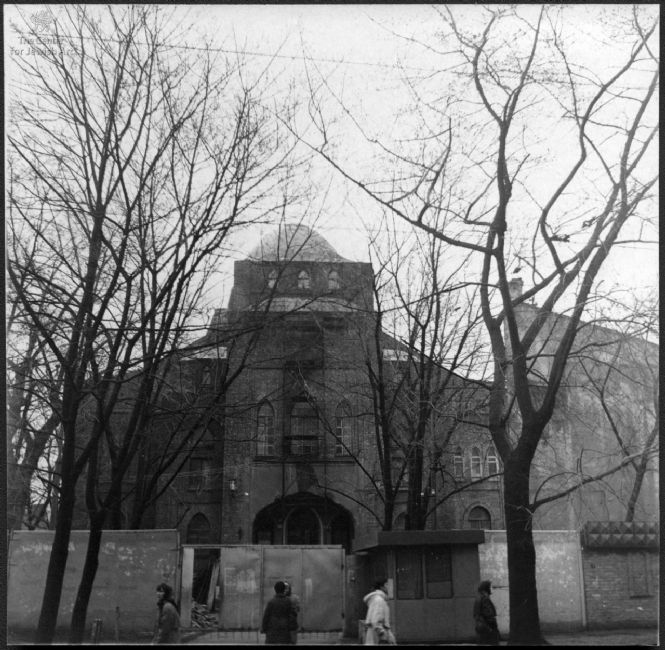
Jews first appeared in Kharkov in the early 18th century, as merchants coming to the town for the annual fair. However, a Jewish community emerged here only in the early 1780s. Although Kharkov lay outside the Pale of Settlement, the only area of the Russian Empire where Jews were allowed to settle, Jews continued to live in the city, suffering from persecution and discrimination. Throughout the 19th century, the bulk of the local Jewish community consisted of Cantonists, Jews conscripted into the Russian Army and stationed in Kharkov. However, as early as the first half of the 19th century, the Russian authorities relaxed the restrictions on Jewish residence in the city. Thus, already in the 1850s the town was home to two distinct Jewish communities: the soldiers and the merchants, each having its own communal institutions. In the 1840s, Kharkov also had a Karaite community of several hundred members, with communal institutions of their own.
The growth of the Jewish community of Kharkov in the second half of the 19th century was connected to the construction of the Kursk-Kharkov-Azov railway, which was financed by the Jewish industrialist and philanthropist Samuil Polyakov. In the 1860s, the local authorities explicitly encouraged the settlement of Jews in the city, to promote Kharkov's economic development. At the time, Jews already made up 20 percent of the students at the local university.
Despite the repressive and discriminatory Russian policies and the general antisemitic atmosphere of the late 19th-early 20th centuries, Jews played a prominent role in the economic life of Kharkov. In 1897, the city was home to 11,013 Jews, who constituted 6.3 percent of Kharkov's total population. In 1880, the renowned Jewish playwright Abraham Goldfaden and his troupe performed in Kharkov for a year. Several local newspapers were published by Jews, who also owned most of the printing houses in the city.
In 1905-1907, the Committee for Assistance to the Victims of Pogroms raised large sums in donations for the victims of the pogroms that had taken place in various localities throughout Ukraine. In the early 20th century, Kharkov had a private Jewish gymnasium for boys, a Jewish kindergarten, as well as a Jewish evening school and pedagogical training courses.
The Jews of Kharkov were active in both all-Russian and Jewish political parties. The entire Jewish political spectrum, from the Zionists to the non-Zionist socialist Bund, was represented in the city.
Following the outbreak of World War I, the Society for Assistance to Poor Jews opened a military hospital for wounded Russian soldiers in the city. Jewish cultural and religious life in Kharkov experienced a boost in those years, as several yeshivot from Poland and Lithuania were evacuated into the city, as were some theaters, including the renowned Vilner Trupe from Vilna.
The Jews of Kharkov were affected by the upheavals of the years of revolution and civil war in Russia. Between 1917 and 1919, the city changed hands several times. Jews suffered from the Red Terror unleashed by the Bolsheviks in May-June 1919. In July that year, during the period of White rule in the city, a meeting between the heads of the Kharkov Jewish community and the supreme commander of the White Volunteer Army, Anton Denikin, prevented a pogrom in the city, although some Jews were robbed, and several Jewish women were raped.
In 1919-1934, Kharkov was the capital of the Ukrainian Soviet Socialist Republic.
Immediately after the reestablishment and stabilization of Soviet rule in Kharkov, the local Jewish communal bodies were dissolved. The restrictions on private economic activity led to the emigration of a number of Jewish industrialists and merchants, and altered the socioeconomic structure of the Jewish community. Many Jews left their former occupations for government service and industry. Some former merchants and artisans turned to agriculture, and a Jewish collective farm named Chervoni Zori (Red Dawns) was established near Kharkov in the late 1920s-early 1930s. In the 1920s and 1930s, many Jews from smaller towns and cities in Ukraine moved to Kharkov in search of new educational and vocational opportunities, and the massive famine that ravaged Ukraine in 1932-1933 brought a new wave of Jewish arrivals, who moved into the city in order to survive.
While Zionist activities were banned, and the local Zionist organizations had to operate clandestinely or semi-clandestinely, Yiddish activities were encouraged. In the 1920s and 1930s, Kharkov became a hub of cultural and educational activities in this language. The Culture League, which promoted cultural activities in Yiddish, ran a theatrical ensemble, which became the Ukrainian State Jewish Theater in 1925. During the 1920s, Kharkov was also home to the Jewish Workers' Theatrical Ensemble, and there was a Jewish Workers' Club housed in the building of the former Choral Synagogue. Numerous Soviet newspapers and periodicals in Yiddish were published in Kharkov in the 1920s and 1930s, such as Der Shtern, Sovetishe Literatur, Di Royte Velt, Yunger Shlogler, and others. In these decades, two chambers of the Kharkov district court held their deliberations in Yiddish, and several police stations in the city used it as their official language.
In 1930, there were three Jewish schools in Kharkov, with Yiddish as the language of instruction. From the 1920s until the late 1930s, the city had a Jewish pedagogical school (technikum), a Jewish mechanical engineering school, and a Jewish department at the local school of journalism. In 1930, a Jewish Workers' University was opened in Kharkov, and it trained technicians for the metalworking industry. There were also Jewish departments at the Kharkov State University and the Kharkov Communist University.
In the late 1930s, all the Jewish activities in Kharkov ceased: The Yiddish-language schools, theaters, and newspapers were either shut down or relocated to Kiev, which had become the capital of Soviet Ukraine in 1934. Many of the Jews of Kharkov fell victim to the Stalinist purges.
In 1939, Kharkov was home to 130,250 Jews, who made up 15.6 percent of the total population.
Most of the Jews managed to leave Kharkov before its occupation by German troops on October 23, 1941. Immediately after taking control of the city, the German authorities instituted a practice of taking hostages from among the Jewish population. At the same time, all the Jews were ordered to hand over money and valuables. In mid-November 1941, after Soviet saboteurs had detonated buildings housing German officers, at least 300 Jewish hostages were murdered. Jews were subjected to discrimination from the beginning of the occupation. Upon the orders of the local Ukrainian administration, Jews were fired from their jobs and forced to subsist on heavily reduced food rations. In early November 1941, the local Ukrainian administration ordered the election of a Judenrat, which was headed by a professor of medicine named Gurevich. Jews also had to wear special armbands. Shortly thereafter, Sonderkommando 4a of Einsatzgruppe C, under the command of Paul Blobel, came to Kharkov, and in mid-December 1941 the Jews were ordered to move into a ghetto, which was established in the barracks of the tractor plant and the machine tool plant on the outskirts of the city (both plants had been evacuated into the Soviet interior). Already during the resettlement, Blobel's men murdered some 300 Jews. Several hundred sick and elderly Jews who could not walk to the ghetto were locked in the building of the former synagogue on Grazhdanskaya Street, and left to starve or freeze to death.
The inmates of the ghetto, which was surrounded with barbed wire, suffered from inhuman overcrowding and hunger. They were given limited time to draw water, and were forbidden to remove the bodies of those who had succumbed to starvation and disease. The ghetto was subjected to constant looting raids by German soldiers and local auxiliaries. The Germans also carried out regular murder operations. More than 1,000 Jews were exterminated in late December 1941 alone. This figure includes the massacre of some 200 mentally ill Jews on December 24, 1941, and the murder of several hundred Jews (who were allegedly sent to work in the Poltava District) on December 27, 1941.
The Kharkov Ghetto was liquidated in early January 1942, and about 10,000 of its inmates were murdered at Drobitskiy Yar near the city. Following the liquidation of the ghetto, Jews who had managed to escape the massacre by going into hiding, but were discovered by local collaborators, were shot at Drobitskiy Yar, as well.
In 1943, Kharkov changed hands several times in the course of Soviet and German offensives and counter-offensives, before being liberated for good by the Red Army on August 23, 1943.
In December 1943, shortly after the liberation, Kharkov became the site of one of the first trials of Nazi war criminals.
Kharkov
Kharkov City District
Kharkov Region
Ukraine (USSR) (today Kharkiv
Ukraine)
49.972;36.243
Photos
Victims' Names
The Choral Synagogue in Kharkov
Center for Jewish Art, The Hebrew University of Jerusalem, Copy YVA 14616628