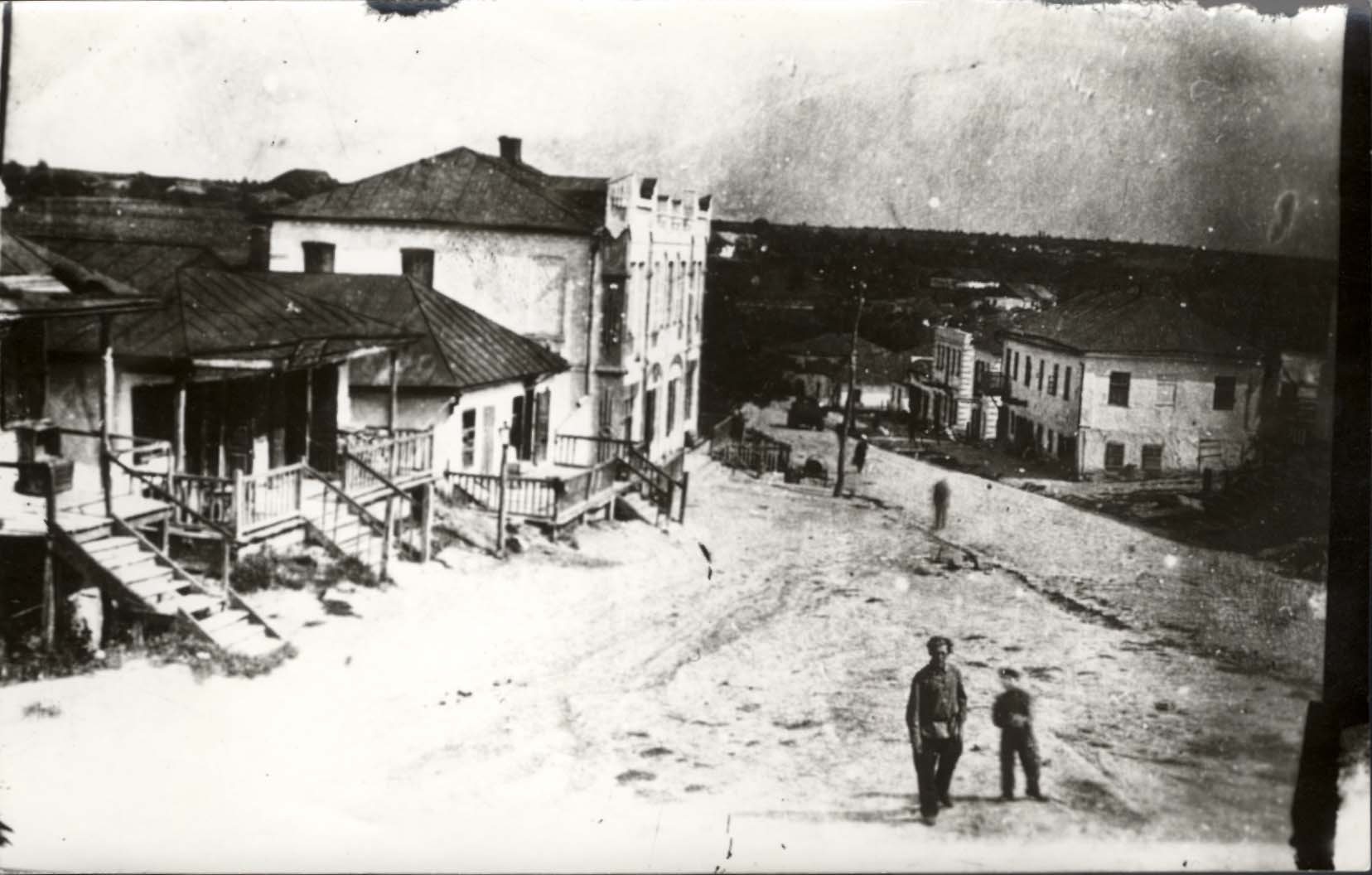
Jews were first mentioned in connection with Sobolevka in the second half of the 18th century. In 1897 the 1,121 Jews who lived in Sobolevka comprised 19.5 percent of the total population.
The Jews of Sobolevka suffered from frequent attacks and looting during the revolutionary years and civil war in Russia. Under Soviet rule many Sobolevka Jews became government officials or workers at the local sugar factory. In the late 1920s the Jewish collective farm Natsmen (abbreviation of Russian "national minority") was established near Sobolevka. Many Jews, especially the young ones, left Sobolevka during the 1920s and 1930s for larger towns and cities in search of new educational and vocational opportunities. The 434 Jews who lived in Sobolevka in 1939 comprised 7 percent of the total population. The local soviet established in the mid-1920s conducted its deliberations in Yiddish. In 1920s-late 1930s there was a Yiddish school in Sobolevka.
In 1939, after the German invasion of Poland, a number of Polish Jewish refugees arrived in the town. Sobolevka was occupied by the Germans on July 28, 1941. Shortly afterwards a ghetto was established and the head of the ghetto, Zhernitskiy, was made responsible for supplying forced laborers for the Germans. The Jews were forced to wear armbands with yellow Stars of David. In April 1942 a group of Sobolevka Jews was deported to a labor camp in Raygorod. In late May 1942 about 400 Sobolevka Jews were shot in the forest near the town.
Sobolevka was liberated by the Red Army on March 12, 1944.