Lodz Ghetto
Place
LODZ Lodz district, Poland. Jews first settled at the end of the 18th century. Within a relatively short time they constituted a third of the population and dominated economic life, mainly in trade and crafts. The first synagogue was built in 1809. Community council elections took place in 1810. The Jewish population increased rapidly, and from 1822 was confined to a Jewish quarter around the market square. The quarter was built up rapidly but was soon overcrowded through the influx of Jews from the surrounding villages attracted by the city's industrial development. In 1861 permission was granted to expand the quarter. About half the Jews of Lodz were involved in purchasing raw materials for the flourishing textile industry and the sale of the manufactured goods within Poland and, after 1850, to Russia. They also opened warehouses for storing yarn sold to the weavers. Jewish tailors, furriers, and hatmakers joined the local guilds and set up their own organizations with their own synagogues. During the early 19th century, Jews entered professional life as lawyers and doctors and entered nursing. Jewish schools were opened in the 1860s. Religious life was dominated by the Hasidim, the majority from the court of the Rabbi of Kotsk and others from the Przysucha and Gur courts. During the second half of the 19th century, Lodz became the second largest Jewish community in Poland (after Warsaw) and one of the largest in the world. The Jewish population in 1897 was 98,671 (32% of the total). The decline in the Jewish population in the late 19th and early 20th century was due to economic crises, Russian administrative restrictions on the import of Polish goods, and the migration of Jews to the U.S. During the last two decades of the 19th century, Jews established factories in Lodz (105 of 261), most of which were small enterprises with fewer employees than in non Jewish-owned industry with its modern equipment. The Jewish contribution, especially in the Jewish-owned textile factories, was the variety of goods manufactured. On the eve of WWI, 7,000 of the 17,000 weavers working on their own looms in their homes – usually the entire family – were Jews. They worked up to 16 hours a day under difficult conditions, in most cases earning less than factory employees. Jews constituted only a small proportion of factory employees because they preferred to retain their independent status, mainly for religious reasons, i.e. the fact that they were unable to work on the Sabbath, and because of the refusal of non Jewish craftsmen (mainly Germans) to train Jews. The Bund in 1897 began to organize Jewish workers clandestinely. Their members joined in mass demonstrations and published underground periodicals. In 1903, a Zionist socialist group was organized which in 1905 became the Po'alei Zion party. The Russians exiled many of the leaders to Siberia after the 1905-07 revolution. In 1903 the Polish Socialist Party (PPS) organized a Jewish section in Lodz. In the first decade of the 20th century, Christian religious preachers incited workers to carry out pogroms against the Jews. Zionist activity began in 1897 and as their numbers increased, the Zionists took over some synagogues and prayer houses and opened a Zionist talmud torah with 800 pupils. An old age home, a hospital, an orphanage, and a school were opened in the early 20th century by Jewish philanthropists. A yeshiva was founded in 1912 and was soon attended by hundreds of students. Other yeshivot were established during WWI or between the World Wars. Modern Jewish schools were opened in Lodz at the end of the 19th century and a vocational school was established in 1907. The first Jewish high school in the Russian Empire was opened by Rabbi Dr. Mordekhai (Markus) Braude in 1912, serving as a model for Jewish high schools throughout Poland during the interwar period. These were bilingual (Hebrew-Polish) schools with national Zionist educational trends. The Zamir society founded by Zionists in 1899 had its own choir and concert hall and in 1905 established a theater troupe. The Bund created its own cultural society (the Arpeh) in 1908. The first Jewish sports association in Poland, Bar Kokhba, was established in Lodz in 1912. In 1908, Jewish newspapers began to appear. Rabbi Eliyahu Hayyim Meisel, who served the community from 1873 to 1912, repudiated Zionism and all political organization, but was popular among the members of the community, especially the Hasidim. A Reform congregation established its own synagogue in 1888 and from 1908 its rabbi was Dr. Braude. He was also secretary of the Jewish faction in the Austrian parliament, chairman of the Jewish Elementary and Secondary School Association of Poland, and an ardent Zionist. In 1908 the periodical Lodzer Tagblat began to appear, and in 1912 Lodzer Morgenblat was published.
From the outbreak of WWI to the German invasion on 6 December 1914, the Jewish population declined from 200,000 to less than 150,000 as a result of evacuation, conscription into the army, and restrictions imposed by the Russians. The Jews moved eastwards or took refuge in surrounding villages to wait out the war. The Germans confiscated all raw materials, manufactured goods, and machinery, and cut off trade with Russia. The situation of the Jews declined radically and at times ended in starvation, sickness, and death. The community and the Jewish political parties provided financial aid, set up soup kitchens, and took steps to relieve the suffering. The Zionist organizations flourished during the war years and some of the synagogues permitted Zionist activities on their premises. The Jewish education system expanded and in 1919 the network of szabasowki elementary schools were attended by 7,694 pupils studying in 184 classes. A number of elementary and high schools were opened where the language of instruction was Hebrew or Yiddish. In 1915, the Zamir society founded an orchestra that per formed with its choir under the baton of leading Jewish conductors. After the war, Jews returned from other towns and villages and the Jewish population increased, to 202,497 (30% of the total) in 1931. Seventy one percent of Jewish workers were employed in small businesses, mainly workshops and cottage industries, earning minimum wages. Manifestations of antisemitism were rife immediately after the war and increased considerably during the 1930s. Students organized anti Jewish riots; youths belonging to the Endecja Party boycotted Jewish shops and destroyed Jewish-owned stalls; and the local press spread Nazi antisemitic propaganda. On 17 February 1936, the Jews held a mass rally protesting manifestations of antisemitism, boycotts, and riots. Agudat Israel controlled the community council from 1931 until the outbreak of WWII. Zionist parties played a leading role in the community and a Zionist representative was elected to the Sejm. Many Jews were supporters of the illegal Communist Party and the Bund was quite strong. Between the World Wars, the majority of the pupils in government high schools were Jews. Three Jewish high schools existed where the language of instruction was Hebrew, the largest (600 pupils) directed by the poet Itzhak Katzenelson (1886-1944), a native of Lodz Agudat Israel ran a network of Yesodei Torah schools for boys and Beth Jacob school for girls. The Beth Jacob national teachers' training seminary was located in Lodz. The Tarbut organization ran adult education classes in Hebrew language and literature and Bible. The Beit Yisrael yeshiva had an enrollment of 400 students. At the local branch of the YIVO Institute for Jewish Research 200 persons were engaged in the study of Jewish topics. The Friends of the Hebrew University founded in Lodz in 1925 had 500 members. The Jewish press flourished, and hundreds of books on rabbinic and general Jewish subjects were published in Yiddish and Hebrew. Jewish theaters thrived between the World Wars with actors famous in the Jewish world appearing on their stages. The Lodz community was proud of the large number of authors who made an important contribution to Yiddish and Hebrew letters. The Polish poet Julian Tuvim was born in Lodz as were the painters Samuel Hirszenberg, Jankel Adler, and Arthur Szyk.
During the first days of WWII, 60,000 Jews fled the city. When the German army entered Lodz on 8-9 September 1939, persecution of Jews began immediately. In addition to physical attacks, Jewish bank accounts were blocked; Jews were forbidden to have more than 2,000 zloty in their possession; and Jews were banned from dealing in textiles. German officials raided Jewish homes and robbed their possessions, stole goods from Jewish-owned shops, and rounded up Jews for menial tasks. Intellectuals and community functionaries were arrested and interned in the Radogoszcz camp. Many were murdered in the nearby forests. Some were transferred to other internment camps and the remainder deported to the General Gouvernement.
On 15-17 November, the Germans set fire to the synagogues or blew them up. The Nazis continued to attack and degrade the Jews in Lodz, especially the rabbis and religious leaders. Jews were forced out of their homes to provide accommodations for German officials. On 12-13 December 1939, thousands of Jews were deported to the General Gouvernement. On 24 January 1940, the Jewish population was ghettoized in the Old City area, the process continuing until 1 March, when the several thousand Jews living in the city were attacked, beaten, and herded into the ghetto. Others were taken to internment camps and some were shot in the nearby forest. On 1 May 1940, there were 163,777 Jews (including 6,471 refugees) within the confines of the ghetto.
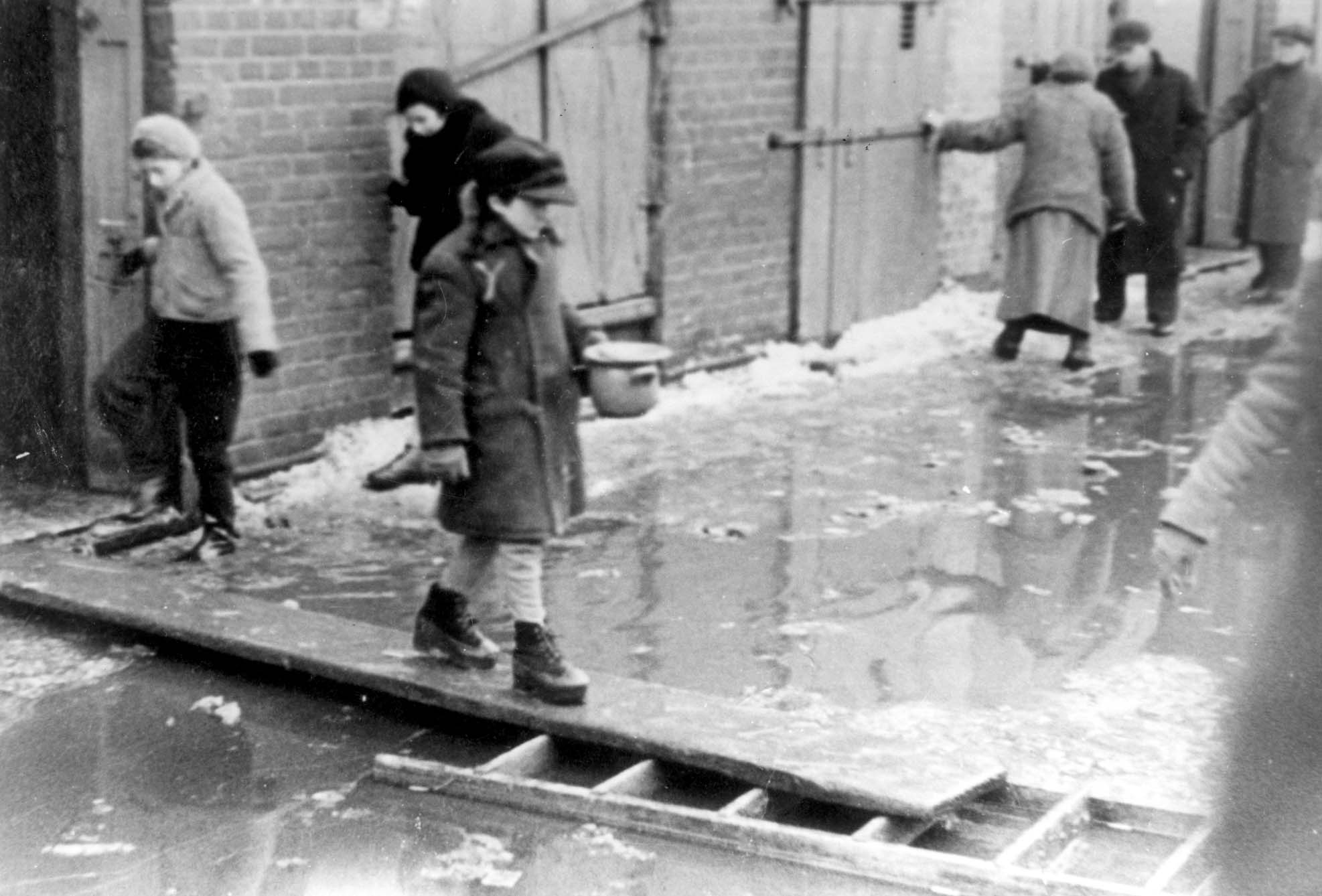
The Germans set up a Judenrat on 13-14 October 1939 and appointed Mordekhai Hayyim Rumkowski chairman with a 31 member council, all of whom were arrested on 11 November 1939 and taken to the Radogoszcz interment camp; only eight returned. A new Judenrat was appointed in January 1940. A Jewish police force was set up under the control of the Judenrat. The overcrowding, lack of drinking water, and primitive sanitary conditions in the ghetto were so acute that a typhus epidemic broke out in March 1940. By September 1940, over 100,000 of the ghetto inhabitants were completely dependent on the Judenrat for their sustenance, as little work was available and the meager food supplies were rationed. By July 1941, to alleviate the situation, 45 workshops for tailoring, shoemaking, woodwork, metalwork, weaving, upholstery, and tanning were set up to fill orders from the German army as well as from private firms and institutions which supplied the raw materials and machinery. This became the main source of income of the ghetto and provided employment for 53,000 workers by March 1942.
As soon as the Jews entered the ghetto, they were made to exchange all their foreign currency for special currency valid in the ghetto only. The Germans also confiscated all jewelry and monies brought in or received from outside. The ghetto committee also expropriated all tools, raw materials, and personal belongings. All these items were registered with the promise to return them after the war. Food was rationed, but many were unable to pay for their entire allotment and the surplus was sold on the black market. Public soup kitchens were opened in summer 1940. Some operated for specific groups: political groups such as the Zionists and the Bund; the intelligentsia; the ultra-Orthodox (kosher kitchens), officials of certain institutions (e.g., the Jewish police, the fire brigade); schoolchildren; and closed welfare institutions. Persons holding public positions or engaged in manual labor were given extra rations. The mortality rate increased throughout the ghetto period, reaching its peak in summer 1942. The main causes of death were heart disease, tuberculosis, and undernourishment. In 1940, 45 religious and secular educational institutions were functioning in the ghetto. These included schools for the deaf and dumb, the retarded, and institutionalized juvenile delinquents, a high school for boys and a high school for girls, and a vocational school. All subjects were taught in Yiddish. The schools were closed down at the end of 1941 when their premises were allocated to refugees. The orphanage in the ghetto (the Kolonia) provided for children aged 7-15 and at its peak housed 1,500 children. Within the ghetto, the political groups – especially the Bund – organized lectures, choir performances and symphony concerts, plays and literary evenings; these events were attended by hundreds of adults and young people. Art exhibits were organized. The artists were augmented at the end of 1941 by an influx of refugee artists from Western Europe. An official archives containing documentation on life in the ghetto was set up and from January 1941 to July 1944 published a daily bulletin. Sections of the archives survived the Holocaust and serve as source material for research on the Lodz community. Archive workers gathered an impressive library of rabbinical and religious works. The Sonnenberg library had some 7,500 books with a readership of 4,000. In 1940, religious services were permitted on the high holidays, but after that none was permitted, although services were held clandestinely. A rabbinical council, functioning alongside the Judenrat, attended to the religious requirements of the ghetto community. The Zionist parties continued to function within the ghetto and their youth groups (950 pioneers) trained in agriculture in over 30 cooperatives. Members of these groups also served as counselors in the Kolonia orphanage and were conscripted for work in the ghetto. These cooperatives operated for about one year. They were disbanded in spring 1941.
Youth work was then restricted to organizing functions and teaching. The conscription of Jews for labor battalions began in December 1940 and by November 1941, 3,859 Jewish males were sent mainly to camps in the Poznan area to build the highway to Frankfurt. In March 1940 and again on 27 July, the Germans took several hundred inmates of mental hospitals, as well as the chronically ill in the Jewish hospitals, to the Zgierz forest and shot them. From 16 January 1942, 10,000 Jews were deported to the Chelmno extermination camp. Another 3,074 followed on 2 April 1942. In October-November 1941, 20,000 Jews from Germany, mainly the elderly and ill, were brought to Lodz and accommodated under the worst conditions, with many starving to death. In May 1942 over half were deported to Chelmno. A further 15,500 Jews from other towns and villages were brought to Lodz. The last stage of the deportations took place at the beginning of September 1942, when 16,000 Jews were sent to their death in Chelmno. Some 90,000 Jews still remained in Lodz, mainly to man the workshops providing goods to the Germans. This labor camp was the last surviving Jewish community in Nazi-occupied Poland. As the destruction of the ghetto progressed, groups of youth organized to carry out underground activities and sabotage. The final deportation of the 76,000 remaining Jews began in June 1944 and continued up to 29 August. The majority were sent to Auschwitz. Rumkowski, who had ruled the ghetto with a high hand, was deported with his family to Auschwitz, where they died. There are differing and conflicting assessments among survivors and researchers of Rumkowski's behavior in the ghetto.
The 900 survivors were liberated by Soviet forces in January 1945. Another 10,000-20,000 survived the war in Nazi camps or in the USSR. After the war, Lodz became the largest Jewish center in Poland and the head offices of Jewish organizations were established there. In fall 1945, 20,000 Jews were registered with the Jewish Community Council. Another 40,000 were registered temporarily. The Council provided accommodation, clothing, medical attention, and employment. The community was given financial assistance by the Joint Distribution Committee. A Jewish elementary school teaching in Yiddish was opened in 1945 and in the course of time it expanded to include a high school. It was closed in 1969 due to lack of pupils. The Zionist movement opened a school in 1945 in which the language of instruction was Hebrew. In the 1947-48 school year it was attended by up to 200 pupils. Writers and artists were attracted to Lodz and an association of writers and journalists was founded whose members organized literary evenings, plays, and concerts. Jewish artists also set up their own organization and organized exhibits. The Central Committee for Jewish History opened its offices in Lodz and up to the end of 1946 published 26 works on the history of the Jews in Poland. Zionist parties renewed their activities in Lodz immediately after the war, as did the youth movements. A branch of the Bund was opened, but all these organizations were disbanded in 1949 with the Soviet domination of Poland. A Jewish congregation whose activities were confined to religious affairs was organized. From 1949 to the 1970s, Jews left Lodz in three waves of emigration to Israel, Western Europe, and the U.S. Only a few hundred remained.
From the outbreak of WWI to the German invasion on 6 December 1914, the Jewish population declined from 200,000 to less than 150,000 as a result of evacuation, conscription into the army, and restrictions imposed by the Russians. The Jews moved eastwards or took refuge in surrounding villages to wait out the war. The Germans confiscated all raw materials, manufactured goods, and machinery, and cut off trade with Russia. The situation of the Jews declined radically and at times ended in starvation, sickness, and death. The community and the Jewish political parties provided financial aid, set up soup kitchens, and took steps to relieve the suffering. The Zionist organizations flourished during the war years and some of the synagogues permitted Zionist activities on their premises. The Jewish education system expanded and in 1919 the network of szabasowki elementary schools were attended by 7,694 pupils studying in 184 classes. A number of elementary and high schools were opened where the language of instruction was Hebrew or Yiddish. In 1915, the Zamir society founded an orchestra that per formed with its choir under the baton of leading Jewish conductors. After the war, Jews returned from other towns and villages and the Jewish population increased, to 202,497 (30% of the total) in 1931. Seventy one percent of Jewish workers were employed in small businesses, mainly workshops and cottage industries, earning minimum wages. Manifestations of antisemitism were rife immediately after the war and increased considerably during the 1930s. Students organized anti Jewish riots; youths belonging to the Endecja Party boycotted Jewish shops and destroyed Jewish-owned stalls; and the local press spread Nazi antisemitic propaganda. On 17 February 1936, the Jews held a mass rally protesting manifestations of antisemitism, boycotts, and riots. Agudat Israel controlled the community council from 1931 until the outbreak of WWII. Zionist parties played a leading role in the community and a Zionist representative was elected to the Sejm. Many Jews were supporters of the illegal Communist Party and the Bund was quite strong. Between the World Wars, the majority of the pupils in government high schools were Jews. Three Jewish high schools existed where the language of instruction was Hebrew, the largest (600 pupils) directed by the poet Itzhak Katzenelson (1886-1944), a native of Lodz Agudat Israel ran a network of Yesodei Torah schools for boys and Beth Jacob school for girls. The Beth Jacob national teachers' training seminary was located in Lodz. The Tarbut organization ran adult education classes in Hebrew language and literature and Bible. The Beit Yisrael yeshiva had an enrollment of 400 students. At the local branch of the YIVO Institute for Jewish Research 200 persons were engaged in the study of Jewish topics. The Friends of the Hebrew University founded in Lodz in 1925 had 500 members. The Jewish press flourished, and hundreds of books on rabbinic and general Jewish subjects were published in Yiddish and Hebrew. Jewish theaters thrived between the World Wars with actors famous in the Jewish world appearing on their stages. The Lodz community was proud of the large number of authors who made an important contribution to Yiddish and Hebrew letters. The Polish poet Julian Tuvim was born in Lodz as were the painters Samuel Hirszenberg, Jankel Adler, and Arthur Szyk.
During the first days of WWII, 60,000 Jews fled the city. When the German army entered Lodz on 8-9 September 1939, persecution of Jews began immediately. In addition to physical attacks, Jewish bank accounts were blocked; Jews were forbidden to have more than 2,000 zloty in their possession; and Jews were banned from dealing in textiles. German officials raided Jewish homes and robbed their possessions, stole goods from Jewish-owned shops, and rounded up Jews for menial tasks. Intellectuals and community functionaries were arrested and interned in the Radogoszcz camp. Many were murdered in the nearby forests. Some were transferred to other internment camps and the remainder deported to the General Gouvernement.
On 15-17 November, the Germans set fire to the synagogues or blew them up. The Nazis continued to attack and degrade the Jews in Lodz, especially the rabbis and religious leaders. Jews were forced out of their homes to provide accommodations for German officials. On 12-13 December 1939, thousands of Jews were deported to the General Gouvernement. On 24 January 1940, the Jewish population was ghettoized in the Old City area, the process continuing until 1 March, when the several thousand Jews living in the city were attacked, beaten, and herded into the ghetto. Others were taken to internment camps and some were shot in the nearby forest. On 1 May 1940, there were 163,777 Jews (including 6,471 refugees) within the confines of the ghetto.
The Germans set up a Judenrat on 13-14 October 1939 and appointed Mordekhai Hayyim Rumkowski chairman with a 31 member council, all of whom were arrested on 11 November 1939 and taken to the Radogoszcz interment camp; only eight returned. A new Judenrat was appointed in January 1940. A Jewish police force was set up under the control of the Judenrat. The overcrowding, lack of drinking water, and primitive sanitary conditions in the ghetto were so acute that a typhus epidemic broke out in March 1940. By September 1940, over 100,000 of the ghetto inhabitants were completely dependent on the Judenrat for their sustenance, as little work was available and the meager food supplies were rationed. By July 1941, to alleviate the situation, 45 workshops for tailoring, shoemaking, woodwork, metalwork, weaving, upholstery, and tanning were set up to fill orders from the German army as well as from private firms and institutions which supplied the raw materials and machinery. This became the main source of income of the ghetto and provided employment for 53,000 workers by March 1942.
As soon as the Jews entered the ghetto, they were made to exchange all their foreign currency for special currency valid in the ghetto only. The Germans also confiscated all jewelry and monies brought in or received from outside. The ghetto committee also expropriated all tools, raw materials, and personal belongings. All these items were registered with the promise to return them after the war. Food was rationed, but many were unable to pay for their entire allotment and the surplus was sold on the black market. Public soup kitchens were opened in summer 1940. Some operated for specific groups: political groups such as the Zionists and the Bund; the intelligentsia; the ultra-Orthodox (kosher kitchens), officials of certain institutions (e.g., the Jewish police, the fire brigade); schoolchildren; and closed welfare institutions. Persons holding public positions or engaged in manual labor were given extra rations. The mortality rate increased throughout the ghetto period, reaching its peak in summer 1942. The main causes of death were heart disease, tuberculosis, and undernourishment. In 1940, 45 religious and secular educational institutions were functioning in the ghetto. These included schools for the deaf and dumb, the retarded, and institutionalized juvenile delinquents, a high school for boys and a high school for girls, and a vocational school. All subjects were taught in Yiddish. The schools were closed down at the end of 1941 when their premises were allocated to refugees. The orphanage in the ghetto (the Kolonia) provided for children aged 7-15 and at its peak housed 1,500 children. Within the ghetto, the political groups – especially the Bund – organized lectures, choir performances and symphony concerts, plays and literary evenings; these events were attended by hundreds of adults and young people. Art exhibits were organized. The artists were augmented at the end of 1941 by an influx of refugee artists from Western Europe. An official archives containing documentation on life in the ghetto was set up and from January 1941 to July 1944 published a daily bulletin. Sections of the archives survived the Holocaust and serve as source material for research on the Lodz community. Archive workers gathered an impressive library of rabbinical and religious works. The Sonnenberg library had some 7,500 books with a readership of 4,000. In 1940, religious services were permitted on the high holidays, but after that none was permitted, although services were held clandestinely. A rabbinical council, functioning alongside the Judenrat, attended to the religious requirements of the ghetto community. The Zionist parties continued to function within the ghetto and their youth groups (950 pioneers) trained in agriculture in over 30 cooperatives. Members of these groups also served as counselors in the Kolonia orphanage and were conscripted for work in the ghetto. These cooperatives operated for about one year. They were disbanded in spring 1941.
Youth work was then restricted to organizing functions and teaching. The conscription of Jews for labor battalions began in December 1940 and by November 1941, 3,859 Jewish males were sent mainly to camps in the Poznan area to build the highway to Frankfurt. In March 1940 and again on 27 July, the Germans took several hundred inmates of mental hospitals, as well as the chronically ill in the Jewish hospitals, to the Zgierz forest and shot them. From 16 January 1942, 10,000 Jews were deported to the Chelmno extermination camp. Another 3,074 followed on 2 April 1942. In October-November 1941, 20,000 Jews from Germany, mainly the elderly and ill, were brought to Lodz and accommodated under the worst conditions, with many starving to death. In May 1942 over half were deported to Chelmno. A further 15,500 Jews from other towns and villages were brought to Lodz. The last stage of the deportations took place at the beginning of September 1942, when 16,000 Jews were sent to their death in Chelmno. Some 90,000 Jews still remained in Lodz, mainly to man the workshops providing goods to the Germans. This labor camp was the last surviving Jewish community in Nazi-occupied Poland. As the destruction of the ghetto progressed, groups of youth organized to carry out underground activities and sabotage. The final deportation of the 76,000 remaining Jews began in June 1944 and continued up to 29 August. The majority were sent to Auschwitz. Rumkowski, who had ruled the ghetto with a high hand, was deported with his family to Auschwitz, where they died. There are differing and conflicting assessments among survivors and researchers of Rumkowski's behavior in the ghetto.
The 900 survivors were liberated by Soviet forces in January 1945. Another 10,000-20,000 survived the war in Nazi camps or in the USSR. After the war, Lodz became the largest Jewish center in Poland and the head offices of Jewish organizations were established there. In fall 1945, 20,000 Jews were registered with the Jewish Community Council. Another 40,000 were registered temporarily. The Council provided accommodation, clothing, medical attention, and employment. The community was given financial assistance by the Joint Distribution Committee. A Jewish elementary school teaching in Yiddish was opened in 1945 and in the course of time it expanded to include a high school. It was closed in 1969 due to lack of pupils. The Zionist movement opened a school in 1945 in which the language of instruction was Hebrew. In the 1947-48 school year it was attended by up to 200 pupils. Writers and artists were attracted to Lodz and an association of writers and journalists was founded whose members organized literary evenings, plays, and concerts. Jewish artists also set up their own organization and organized exhibits. The Central Committee for Jewish History opened its offices in Lodz and up to the end of 1946 published 26 works on the history of the Jews in Poland. Zionist parties renewed their activities in Lodz immediately after the war, as did the youth movements. A branch of the Bund was opened, but all these organizations were disbanded in 1949 with the Soviet domination of Poland. A Jewish congregation whose activities were confined to religious affairs was organized. From 1949 to the 1970s, Jews left Lodz in three waves of emigration to Israel, Western Europe, and the U.S. Only a few hundred remained.
Country Name
1918
Russian Empire
1919-1938
Poland
1938-1939
Poland
1939-1940
Germany
1940-1941
Germany
1941-1945
Germany
1945-1990
Poland
Present
POLAND
Łódź
Ghetto
Poland
51.802;19.476
Bibliography
Photos and Videos
- Google Maps within https://www.google.co.il/maps
- Horwitz, Gordon J., Ghettostadt: Łódź and the making of a Nazi city (Cambridge, Massachusetts: Harvard University Press, 2009).
- THE GHETTO ANTHOLOGY MOGILANSKI
- Trunk, Isaiah; Shapiro, Robert Moses, Łódź Ghetto: A History (Bloomington, Ind., Indiana University Press, 2008).